
What Are the Main Reasons Businesses Fail? The Complete Founder Guide to Building a Sustainable Business
The main reasons businesses fail include lack of market demand, poor startup validation, weak product-market fit, cash flow problems, ineffective business models, weak leadership, premature scaling, poor customer acquisition strategies, operational inefficiencies, and founder burnout.
While many people believe businesses fail because they run out of money, the reality is that financial problems are usually symptoms of deeper issues rooted in poor assumptions, weak execution, and a lack of customer understanding.
Understanding the main reasons businesses fail helps founders make better decisions, reduce risk, and build more sustainable companies.
Why does understanding business failure matter?
Understanding the main reasons businesses fail gives founders valuable insights into the decisions and patterns that separate successful businesses from failed ones.
Every entrepreneur studies successful companies, but few spend enough time analyzing failed ones. Yet failure often provides valuable lessons by revealing the assumptions, decisions, and execution gaps that hinder growth. Understanding these patterns can help founders avoid costly mistakes, make better decisions, and build stronger businesses.
The Hidden Truth About Business Failure
Most businesses do not fail because of a single mistake. Instead, failure is often the result of small issues that go unnoticed and compound over time. What appears to be a financial problem is frequently rooted in deeper strategic challenges. This is why successful founders focus on identifying risks early and addressing problems before they become difficult to reverse.
The Business Failure Pyramid
Business failure usually follows a predictable structure.
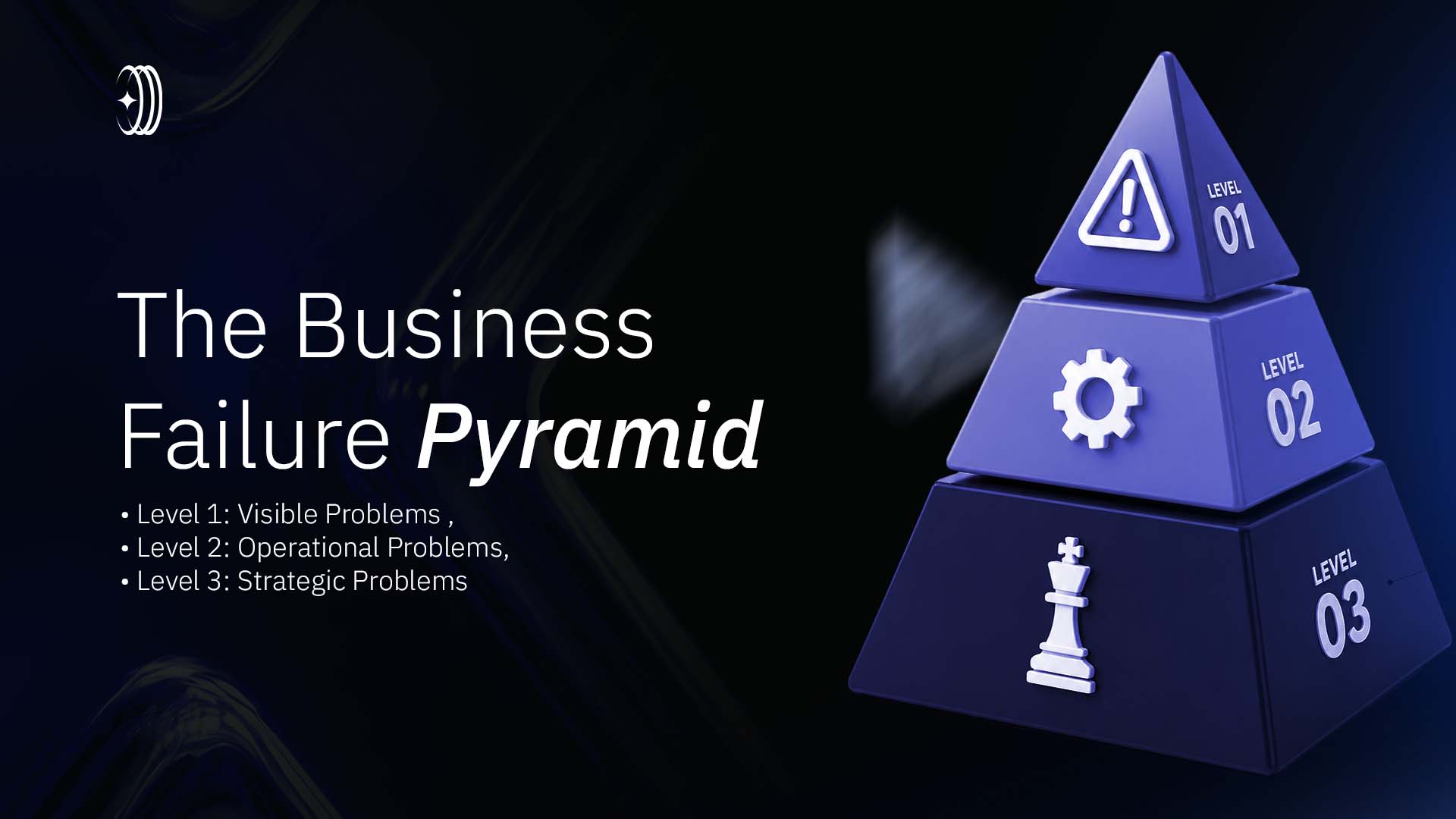
Level 1: Visible Problems
These are the symptoms most people notice:
- Declining revenue
- Poor cash flow
- Customer churn
- Missed growth targets
- Employee turnover
Level 2: Operational Problems
These issues sit beneath the surface:
- Weak execution
- Poor team alignment
- Inefficient processes
- Slow decision-making
Level 3: Strategic Problems
The deepest layer contains the true causes:
- Poor validation
- Lack of demand
- Weak business model
- Incorrect assumptions
Most businesses focus on fixing Level 1 while ignoring Levels 2 and 3.
Successful businesses do the opposite. The Business Failure Pyramid explains the main reasons businesses fail by revealing how visible problems often stem from deeper operational and strategic issues.
The Main Reasons Businesses Fail:
The following are the main reasons businesses fail, based on common patterns observed across startups and established companies.
1. Lack of Market Demand
The most common reason businesses fail is a lack of market demand. Many founders become attached to an idea and assume customers will value it as much as they do. However, even the most innovative product can fail if it does not solve a problem people genuinely care about. Successful businesses validate demand before investing heavily in building solutions.
According to CB Insights, lack of market need consistently ranks among the leading causes of startup failure.
2. Poor Startup Validation
Validation is often mistaken for positive feedback from friends or potential users. In reality, validation is about gathering evidence that a problem exists, matters to customers, and is worth paying to solve. Many startups fail because they mistake interest for real demand and build products before proving customers are willing to commit.
3. Weak Product-Market Fit
Product-market fit occurs when a product consistently solves an important problem for a specific audience. Many businesses generate early traction but struggle to grow because they never fully achieve it. As a result, customer retention remains weak, growth becomes inconsistent, and scaling becomes increasingly difficult.
4. Cash Flow Problems
Cash flow remains one of the most common causes of business failure. While profit reflects long-term performance, cash flow determines whether a business can continue operating day to day. Even profitable companies can fail if they cannot cover salaries, suppliers, and operational expenses when payments are due.
The U.S. Small Business Administration also highlights effective cash flow management as a critical factor in maintaining business stability.
5. Weak Business Models
A strong product does not guarantee a strong business. Many founders create products that customers value but struggle to build sustainable revenue models around them. Without clear answers to how value is created, delivered, and captured, long-term growth becomes difficult to sustain.
6. Building the Wrong Product
Many businesses fail because they focus on building features before fully understanding customer problems. Customers do not buy products because they are technically impressive; they buy solutions that address real challenges. Successful founders spend more time validating customer needs than developing unnecessary functionality.
7. Poor Go-To-Market Strategy
Many founders assume a good product will sell itself, but even great products require a clear path to market. A strong go-to-market strategy defines how customers discover, evaluate, and purchase a product. Without one, businesses often struggle to generate awareness, demand, and predictable growth.
8. Premature Scaling
Premature scaling occurs when businesses expand before validating their model. Early traction often creates the illusion that the company is ready to grow, leading to increased hiring, spending, and expansion. However, scaling too early typically amplifies existing weaknesses instead of solving them.
9. Poor Leadership and Decision-Making
Behind every successful business is a series of informed decisions, while behind every failed business is often a series of poor ones. Strong leadership requires making sound decisions under uncertainty, relying on evidence rather than assumptions, and adapting when new information becomes available.
10. Founder Ego and Cognitive Bias
Many founders become trapped by their own beliefs and assumptions. Instead of listening to customers and objectively testing ideas, they become increasingly committed to their original vision. This often prevents businesses from recognizing problems early and making necessary adjustments.
11. Ignoring Customer Feedback
Customers provide one of the most valuable sources of business insight, yet many companies stop listening after launch. Over time, this creates a disconnect between what customers actually need and what the business continues to build. The result is often declining engagement, retention, and relevance.
12. Hiring the Wrong Team
A company’s growth is heavily influenced by the quality of its team. Poor hiring decisions can slow execution, reduce accountability, and create cultural challenges. The strongest teams are built around competence, ownership, alignment, and the ability to adapt as the business evolves.
13. Lack of Operational Systems
Many growing businesses become overly dependent on founders, with key processes and decisions concentrated in a few individuals. While this may work initially, it quickly becomes a bottleneck. Operational systems help create consistency, improve efficiency, and support sustainable growth.
14. Competitive Blindness
Markets are constantly changing as competitors evolve, customer expectations shift, and new technologies emerge. Businesses that focus only on internal operations often fail to recognize these changes until they begin losing market share. Long-term success requires continuous awareness of the competitive landscape.
15. Failure to Adapt
Adaptability is one of the most important traits of successful businesses. Markets, technologies, and customer behaviors evolve continuously, and companies that resist change often struggle to remain relevant. The businesses most likely to succeed are those that continuously learn, adjust, and evolve.
Business Failure Case Studies:
These examples demonstrate how the main reasons businesses fail appear in real businesses across different industries.
Kodak
Kodak dominated photography for decades and even helped develop early digital camera technology. However, leadership was slow to embrace the shift to digital, fearing it would impact film sales. While the market evolved, Kodak failed to adapt quickly enough and eventually filed for bankruptcy protection.
Lesson
Ignoring innovation can be more dangerous than competition.
Blockbuster
At its peak, Blockbuster operated thousands of stores worldwide.
When Netflix introduced a subscription-based streaming model, Blockbuster underestimated the shift in consumer behavior. The company remained committed to its traditional model while customer preferences changed.
Lesson
Businesses fail when they become attached to existing success.
Nokia
Nokia once controlled the global mobile phone market.
The company recognized the smartphone trend but moved too slowly while competitors accelerated innovation.
Lesson
Market leadership today does not guarantee market leadership tomorrow.
MADAAR Business Rescue Framework:
Madaar Business Rescue Framework helps businesses diagnose challenges, restore performance, and achieve sustainable long-term growth.
Restoring Growth. Strengthening Foundations.
Many businesses do not fail because of a poor idea; they struggle because of misalignment, weak execution, operational inefficiencies, and the inability to adapt to changing market conditions.
Madaar Business Rescue Framework is a structured methodology designed to identify critical business challenges, stabilize operations, and rebuild the foundations required for sustainable growth. By combining strategic analysis, operational improvements, product optimization, technology, and growth execution, Madaar helps businesses regain momentum and prepare for long-term success.
Framework Pillars
01. Business Diagnosis
Understand the Reality
We conduct a comprehensive assessment of the business to identify operational bottlenecks, financial inefficiencies, product gaps, market challenges, and organizational risks.
02. Root Cause Analysis
Identify Why Performance Declined
Rather than addressing symptoms, we determine the underlying causes affecting growth, customer acquisition, profitability, operational efficiency, and execution.
03. Strategic Realignment
Reconnect Strategy with Market Needs
We reassess positioning, target customers, business model, pricing, product strategy, and competitive differentiation to restore strategic direction.
04. Operational Transformation
Optimize How the Business Operates
We redesign operational workflows, governance structures, team responsibilities, performance management, and internal systems to improve execution.
05. Product & Technology Enhancement
Strengthen the Core Offering
We evaluate the product experience, technology architecture, customer journey, and digital capabilities to improve performance and scalability.
06. Growth Recovery
Return to Sustainable Growth
We implement growth strategies focused on customer acquisition, retention, marketing optimization, partnerships, revenue expansion, and performance measurement.
Business Failure Risk Assessment
Use the following assessment to evaluate your current risk level.
Validation
- Have you spoken with at least 20 potential customers?
- Have customers expressed willingness to pay?
- Have you tested demand?
Product
- Are customers actively using the product?
- Is retention improving?
- Are referrals increasing?
Growth
- Do you know your acquisition costs?
- Do you understand your conversion rates?
- Do you have repeatable growth channels?
Operations
- Are processes documented?
- Are responsibilities clear?
- Are KPIs tracked consistently?
Finance
- Do you have accurate forecasts?
- Do you monitor cash flow regularly?
- Do you know your runway?
If several answers are “No,” the business may face elevated risk.
Understanding the main reasons businesses fail also helps founders identify the habits and systems that successful businesses consistently apply.
What Do Successful Businesses Do Differently?
Businesses that survive and grow tend to share common characteristics.
They:
- Validate before building
- Focus on customer problems
- Measure everything important
- Build lean systems
- Adapt quickly
- Scale gradually
- Invest in operational excellence
Most importantly, successful businesses treat learning as a competitive advantage. They continuously gather insights, test assumptions, and adapt based on what the market teaches them. Success is rarely the result of a single breakthrough or one exceptional decision; more often, it is the outcome of hundreds of disciplined choices made consistently over time.
Frequently Asked Questions:
What is the biggest reason businesses fail?
The most common reason is a lack of market demand. Many businesses build products or services without validating whether customers truly need them.
Why do startups fail more often than established companies?
Startups operate with greater uncertainty, fewer resources, and unproven business models, making validation and execution significantly more important.
Can a profitable business still fail?
Yes. A business can be profitable on paper but still fail due to poor cash flow management and liquidity challenges.
What is product-market fit?
Product-market fit occurs when a product consistently solves a meaningful problem for a clearly defined customer segment, leading to strong adoption and retention.
How can founders reduce business failure risk?
By validating demand early, understanding customer needs, building lean MVPs, measuring performance, and scaling only after achieving product-market fit.
Is a lack of funding the main reason businesses fail?
Not necessarily. Funding issues are often a symptom of deeper problems such as weak validation, poor execution, or an unsustainable business model.
Why do businesses fail after early success?
Many businesses fail after initial growth because they scale too quickly, lose focus, ignore operational systems, or fail to adapt to changing market conditions.
What is the difference between a business problem and a product problem?
A business problem affects the company’s overall sustainability, while a product problem affects the value delivered to customers. Product problems often evolve into business problems if left unresolved.
How important is customer feedback?
Customer feedback is critical. It helps businesses identify weaknesses, improve products, and remain aligned with market needs.
How do successful founders make decisions?
Successful founders rely on evidence, customer insights, data, experimentation, and structured decision-making frameworks rather than assumptions alone.
Most businesses do not fail because of a single mistake. More often, they fail because small risks and overlooked issues accumulate over time until they become impossible to ignore. The businesses most likely to succeed are not necessarily those with the best ideas, the largest budgets, or the strongest networks. Instead, they are the ones who understand their customers, validate assumptions, execute consistently, and adapt when market realities challenge their plans. Understanding the main reasons businesses fail is not about avoiding every mistake. It is about identifying risks early, learning quickly, and building stronger businesses. It is about identifying risks early, learning quickly, and building systems that improve the chances of long-term success. Ultimately, the goal is not perfection, but resilience.






3 Comments